
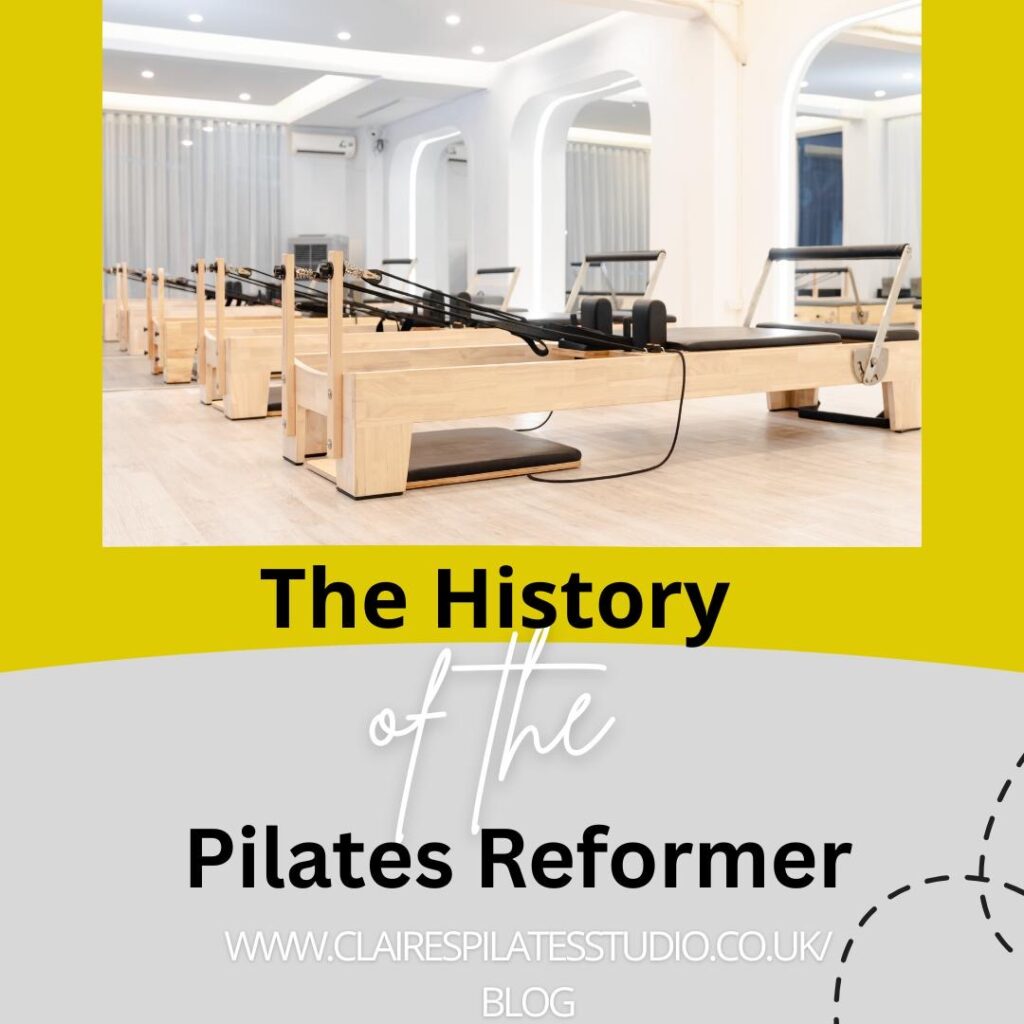
The Pilates Reformer has become one of the most recognizable pieces of fitness equipment in the world. Sleek, spring-loaded, and endlessly versatile, it’s used by everyone from elite athletes to physotherapy patients. But behind its modern popularity lies a fascinating history rooted in rehabilitation, innovation, and a deep understanding of the human body.
At our studio, the Pilates Reformer is more than a piece of equipment. It’s the foundation of a movement method that has transformed bodies for over a century. Elegant, effective, and endlessly adaptable, the Reformer offers a unique approach to fitness that builds strength, improves posture, and supports long-term wellness.
To truly appreciate why the Reformer is so powerful, it helps to understand where it came from and the thoughtful system behind it.
The Origins: Joseph Pilates and Contrology
The Pilates Reformer was invented in the early 20th century by Joseph Hubertus Pilates, a German-born physical trainer. As a child, Pilates struggled with asthma, rickets, and rheumatic fever, which fuelled his lifelong study of anatomy, movement, and physical conditioning.
During World War I, Pilates was interned in England as a foreign national. It was there, while working as a nurse in hospital camps, that the foundations of the Reformer were born. Faced with injured and bedridden soldiers, Pilates began attaching springs to hospital beds, allowing patients to exercise while lying down. This innovative setup helped injured soldiers regain strength and mobility without standing – an idea far ahead of its time.
Pilates called his method “Contrology”, emphasising mindful, controlled movement rather than brute strength. The bed-spring contraptions eventually evolved into what we now recognise as the Pilates Reformer.
From Hospital Beds to Studios
In the 1920s, Joseph Pilates emigrated to the United States and opened a studio in New York City with his wife, Clara. Their studio happened to be located near several dance companies, and dancers quickly embraced the Reformer for both rehabilitation and performance conditioning.
Legends such as George Balanchine sent injured dancers to Pilates, helping cement the Reformer’s reputation as a tool for healing as well as high-level training. Over time, the apparatus was refined—adding the sliding carriage, adjustable springs, straps, and footbar, while staying true to Pilates’ original principles.
Beyond the Reformer: Joseph Pilates’ Other Innovations
While the Reformer is the most famous of Joseph Pilates’ inventions, it was only one part of a much larger system of apparatus he designed to support his method of Contrology. Pilates believed that different bodies and different goals required different tools, and he engineered each machine with a specific purpose in mind.
Some of the most notable Pilates apparatus include:
- The Cadillac (or Trapeze Table): Originally developed alongside the Reformer, the Cadillac evolved from hospital bed setups. It uses springs, bars, and straps to assist with rehabilitation, improve spinal mobility, and build strength with support.
- The Wunda Chair: Compact but challenging, this chair was designed to bring Pilates practice into small spaces. It focuses on balance, unilateral strength, and deep core control.
- The High Chair (Electric Chair): Similar to the Wunda Chair but taller, it emphasises standing work, leg strength, and postural alignment.
- The Spine Corrector: A curved barrel designed to support and mobilize the spine, improving posture, flexibility, and thoracic extension.
- The Ladder Barrel: Created to open the spine and hips while building strength, especially useful for advanced flexibility and extension work.
- The Pedi-Pole: A vertical pole with springs used to train posture, alignment, and whole-body integration.
- The Magic Circle: Though not a machine, this small resistance ring remains one of Pilates’ most enduring tools for strengthening and proprioception.
Together, these apparatus form a cohesive system rather than standalone pieces of equipment. Pilates intended them to complement mat work and one another, offering a fully adaptable method for strength, mobility, rehabilitation, and performance.
Why the Reformer Is So Effective
What makes the Pilates Reformer unique is its ability to adapt to virtually any body and fitness level. Its design allows exercises to be assisted or resisted, making it equally valuable for beginners and advanced practitioners.
Key Benefits of the Pilates Reformer
- Full-Body Strength
The Reformer targets both large muscle groups and deep stabilising muscles, especially the core. Unlike traditional weight training, it emphasises balanced strength rather than muscle isolation. - Improved Posture and Alignment
Many exercises focus on spinal alignment, pelvic stability, and shoulder positioning. Over time, this helps counteract poor posture from desk work and daily habits. - Low-Impact, Joint-Friendly Movement
Because the carriage glides smoothly and resistance comes from springs rather than gravity alone, the Reformer reduces joint strain—making it ideal for rehabilitation and injury prevention. - Enhanced Flexibility and Mobility
Exercises move the body through controlled ranges of motion, improving flexibility while simultaneously strengthening muscles, rather than stretching them passively. - Mind–Body Connection
True to Pilates’ original philosophy, Reformer workouts demand concentration, breath control, and precision. This mindful approach not only improves movement quality but also reduces stress. - Customizable for Rehabilitation
Physical therapists and trained instructors can modify spring tension, positioning, and exercises to suit post-injury recovery, chronic pain management, or postural correction.
The Reformer Today
Today’s Pilates Reformers may look more polished—with aluminium frames, padded carriages, and advanced adjustability—but the concept remains remarkably faithful to Joseph Pilates’ original vision. Whether in boutique studios, gyms, or physiotherapy clinics, the Reformer continues to bridge the gap between strength training, mobility work, and rehabilitation.
A Legacy of Intelligent Movement
More than a century after its invention, the Pilates Reformer endures because it works with the body, not against it. Its history reminds us that effective movement doesn’t need to be punishing or extreme – it needs to be intelligent, intentional, and adaptable.
What sets Pilates apart is its focus on quality over quantity. Every movement has intention. Every exercise serves a purpose. Whether you’re stepping into the studio for the first time or deepening an existing practice, the Pilates Reformer meets you where you are, and helps you move forward with strength and confidence.
At its core, Pilates is about building a body that feels strong, balanced, and capable for life. More than 100 years after its creation, the Reformer remains one of the most effective tools for doing exactly that. In a fitness world that constantly chases the next trend, the Pilates Reformer stands as a timeless example of how thoughtful design and mindful movement can create lasting results.
For information on our Beginner Reformer classes, or if you would like to train to become a Pilates teacher contact me.