
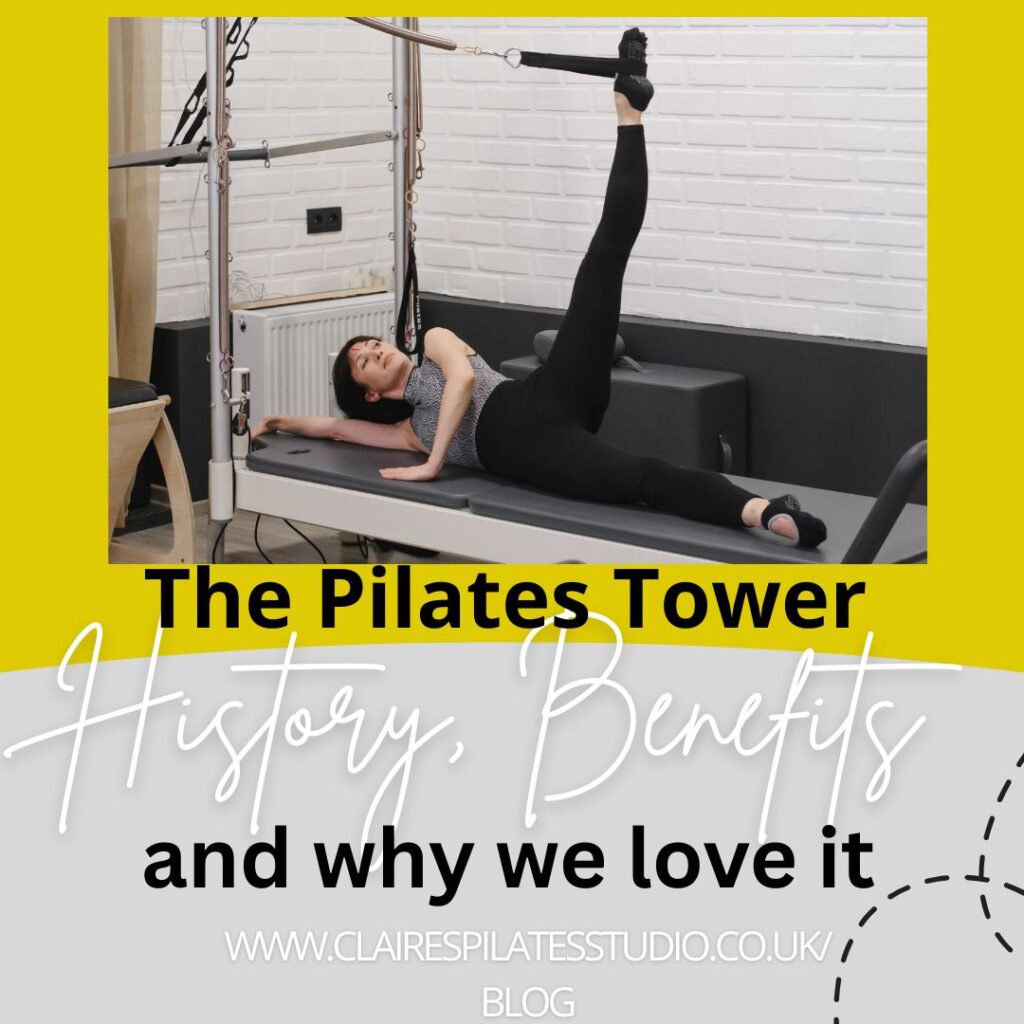
If you’re familiar with Pilates, chances are you’ve heard of the Mat and the Reformer. But there is another wonderfully versatile piece of Pilates apparatus that deserves just as much attention: the Pilates Tower.
With its springs, bars and straps, the Tower can look a little mysterious at first. But once you understand where it came from and how it works, it’s easy to see why it has become such a valuable addition to the modern Pilates studio.
Where Did the Pilates Tower Come From?
To understand the Tower, we need to go back to Joseph Pilates and the development of his original method, which he called Contrology.
Joseph Pilates was not only an innovative teacher of movement; he was also a prolific inventor. He designed a range of apparatus using springs to provide resistance and assistance, including the Reformer, Wunda Chair, Barrels and the apparatus that became known as the Cadillac or Trapeze Table.
The Cadillac consisted of a raised padded table surrounded by a metal frame. Springs, bars and straps could be attached at different heights, allowing Joseph Pilates to create an enormous variety of exercises.
Early versions were referred to as the Massage Table, Rehabilitation Table or Table with Trapeze. Historical accounts describe a padded table with a metal frame at one end, providing attachment points for arm and leg springs and a Roll-Down Bar.
According to Pilates teacher Romana Kryzanowska, the name Cadillac came from one of Joseph Pilates’ clients in the 1940s — a reference to the Cadillac motor car, which at the time represented luxury and quality.
From the Cadillac to the Tower
The modern Pilates Tower developed as a more compact way of accessing much of the spring-based repertoire of the Cadillac.
Instead of the large four-sided overhead frame of a full Cadillac, the Tower concentrates the spring attachments and bars at one end. Modern Towers may be wall mounted, used with a raised mat or, increasingly, attached to a Pilates Reformer.
This makes the Reformer Tower particularly exciting because one piece of apparatus can offer two quite different Pilates experiences.
The Reformer gives us the familiar moving carriage, while the Tower allows us to work from a stable mat using springs, straps, a Roll-Down Bar and Push-Through Bar. Modern Reformer Tower systems are designed specifically to provide much of the Trapeze Table repertoire while taking up considerably less studio space.
And although the equipment has evolved, the principle behind it is very much in keeping with Joseph Pilates’ original work: using spring resistance to help the body move with strength, control and precision.
What Does Pilates Tower Feel Like?
One of the things I love about Tower work is how different it feels from the Reformer.
On the Reformer, we often have the challenge of controlling a moving carriage. On the Tower, the mat is stable and the springs move instead.
That change completely alters the experience.
Springs can provide resistance, making an exercise more challenging, but they can also provide assistance, helping you access movements, stretches and ranges of motion that might otherwise be difficult.
This combination makes Tower Pilates incredibly adaptable.
What Are the Benefits of Pilates Tower?
1. Whole-Body Strength
Tower exercises can work the entire body.
Using springs for the arms and legs allows us to strengthen the upper body, lower body and core while maintaining the whole-body integration that is fundamental to Pilates.
Rather than simply isolating individual muscles, we can teach the body to work as a coordinated system.
2. Core Strength and Stability
Many Tower exercises require the trunk to remain controlled while the arms or legs move against spring resistance.
This creates a wonderful challenge for the deep abdominal muscles and the muscles that support the spine and pelvis.
The result isn’t simply “strong abs” — it’s improved whole-body stability and control.
3. Improved Mobility and Flexibility
This is one of the areas where the Tower really shines.
Because the springs can assist movement, we can explore mobility without forcing the body into position. Exercises using the leg springs or Push-Through Bar can feel fantastic for opening the hips, mobilising the spine and creating a sense of length through the body.
The spring feedback can make stretching feel both supported and active.
4. Resistance AND Assistance
This is one of the cleverest things about Pilates apparatus.
A spring isn’t simply a weight.
Depending on the exercise and where the spring is positioned, it can either make movement harder or help make movement easier.
That means we can adapt exercises to suit different bodies, different abilities and different goals.
5. Excellent Feedback
Pilates is all about developing awareness of how your body moves.
The springs give immediate feedback.
If one leg is doing more work than the other, if you’re losing control through part of a movement or if you’re rushing, you can often feel it straight away.
Over time, this can help improve body awareness, coordination and movement quality.
6. Huge Exercise Variety
Tower Pilates gives us an enormous repertoire of exercises.
We can work lying down, sitting, kneeling, side lying and standing. We can use arm springs, leg springs, bars and straps and move the body in many different directions.
The Cadillac and Tower repertoire ranges from gentle supported movements through to extremely challenging advanced exercises.
This variety means classes can continually progress rather than simply repeating the same exercises week after week.
Tower Pilates vs Reformer Pilates – Which Is Better?
Neither!
They simply offer different challenges.
The Reformer is wonderful for dynamic movement, strength, coordination and controlling the moving carriage.
The Tower gives us a stable base with springs pulling from different directions, opening up a completely different repertoire of exercises and movement experiences.
In fact, I think they complement each other beautifully.
If you’ve been doing Reformer Pilates for some time, Tower work can make familiar Pilates principles suddenly feel completely different. You may discover weaknesses you didn’t realise you had, find new mobility or finally understand an exercise you’ve struggled with elsewhere.
And that’s one of the things I have always loved about Pilates: there is always something else to learn about your body.
A Modern Apparatus With Traditional Pilates Roots
Pilates has changed enormously since Joseph and Clara Pilates opened their New York studio in the 1920s, but the principles behind the method remain remarkably relevant.
The Tower allows us to take ideas from Joseph Pilates’ original apparatus and bring them into a format that works beautifully in today’s Pilates studio.
It can challenge strong, experienced clients while also offering support and assistance when needed.
Most importantly, it allows us to do what Pilates was always intended to do — work the whole body, improve movement and develop strength, mobility, control and confidence.
And if you already love the Reformer, I have a feeling you’re going to love discovering the Tower too.
Reformer Tower classes at Claire’s Pilates Studio PLUS Reformer Tower Teacher Training!
Get ready to experience your Pilates practice in a whole new way!